Best Portable Power Station for Camping UK (2026)
Five picks for every camping style — from ultralight weekend trips to van life and glamping — with real UK runtimes, honest pros and cons, and a full comparison table.
Some links on this page are affiliate links. We may earn a commission if you buy through them, at no extra cost to you.
- Phone charging x4 — 30Wh
- LED lantern 6hrs — 30Wh
- Bluetooth speaker — 15Wh
- Laptop top-up — 40Wh
- 12V cool box (40W) — 300Wh/day
- Phones, lights, camera — 80Wh
- Laptop work sessions — 100Wh
- 12V fridge running — 400Wh/day
- All devices + lights — 150Wh
- Laptop all day — 200Wh
Quick comparison
| Model | Capacity | Output | Weight | Price | Best for | Link |
|---|---|---|---|---|---|---|
| Jackery Explorer 500 v2 | 512Wh | 500W | 6.4kg | ~£339 | Weekend camping | Buy |
| EcoFlow RIVER 2 Pro | 768Wh | 800W | 8.2kg | ~£499 | All-round camping | Buy |
| Jackery Explorer 1000 v2 | 1,070Wh | 1,500W | 10.8kg | ~£429 | Van life / fridge | Buy |
| EcoFlow RIVER 3 Max | 572Wh | 1,200W | 8.0kg | ~£399 | High output, budget | Buy |
| Anker SOLIX C800 | 768Wh | 800W | 9.1kg | ~£399 | Reliable brand pick | Buy |
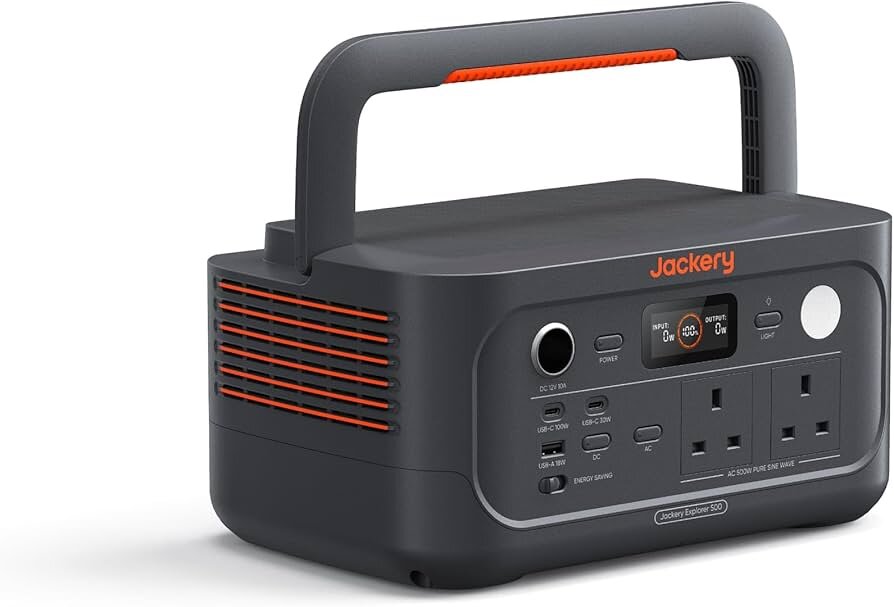
1. Jackery Explorer 500 v2 — Best for weekend camping
Lightest pick~£339 on Amazon UK
The lightest quality power station in this list at 6.4kg. That matters more than you think when you are loading up the car for a camping trip. The 512Wh capacity handles a full weekend comfortably — phones, a lamp, a speaker and a laptop top-up — and Jackery's plug-and-play simplicity means it works without any setup faff. The 500W output won't run a kettle, but a travel kettle (800W) won't either, so take a gas one instead.
Real camping runtimes: 12V cool box (40W) ~10hrs · Phone charges ~30 · LED lamp ~40hrs · Laptop charges ~8
Pros: Lightest quality pick; simplest UI in the market; 6,000-cycle LFP battery; Jackery UK support. Cons: 500W won't run full-size appliances; no pass-through charging.
Check price on Amazon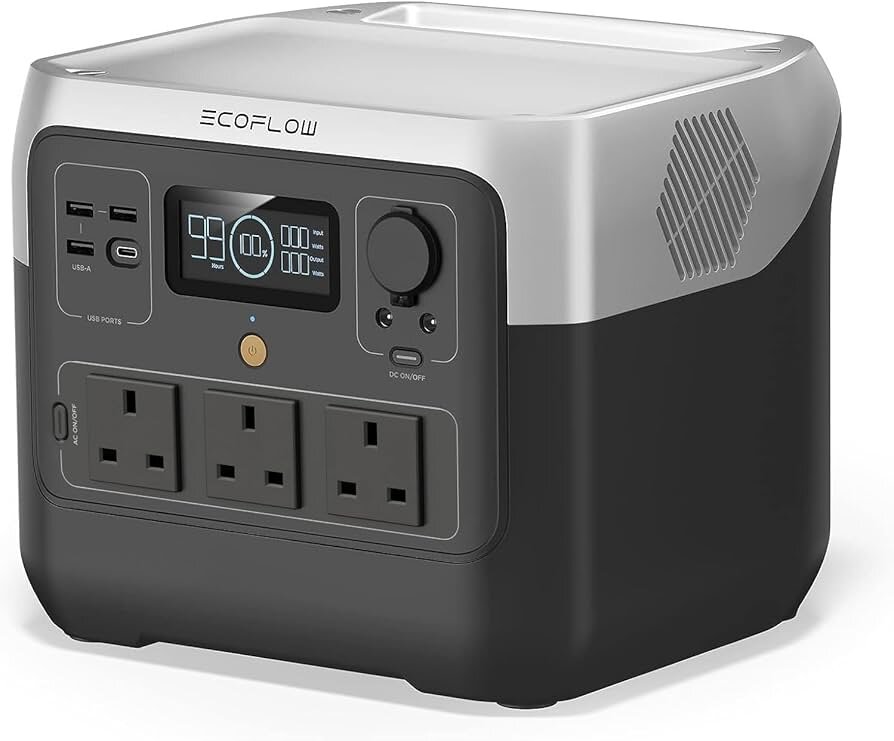
2. EcoFlow RIVER 2 Pro — Best all-round camping pick
Top pick~£499 on Amazon UK
The 70-minute recharge time is the reason this tops the camping list. At a campsite with a hook-up, or at a motorway services stop, you can go from empty to full while you eat. The 768Wh is enough for multi-day trips without solar, X-Boost stretches the effective output to 1,600W, and four AC outlets means everyone charges at once. The TUV Rheinland safety certification is genuinely reassuring in an enclosed space like a caravan or awning.
Real camping runtimes: 12V cool box (40W) ~15hrs · Phone charges ~45 · Laptop charges ~10 · LED TV 24" ~8hrs
Pros: 70-min charge at any hook-up; TUV safety certified; 4 AC outlets; X-Boost extends device compatibility; 5-year warranty. Cons: More expensive than lighter alternatives; 8.2kg is heavier than Jackery 500 v2.
Check price on Amazon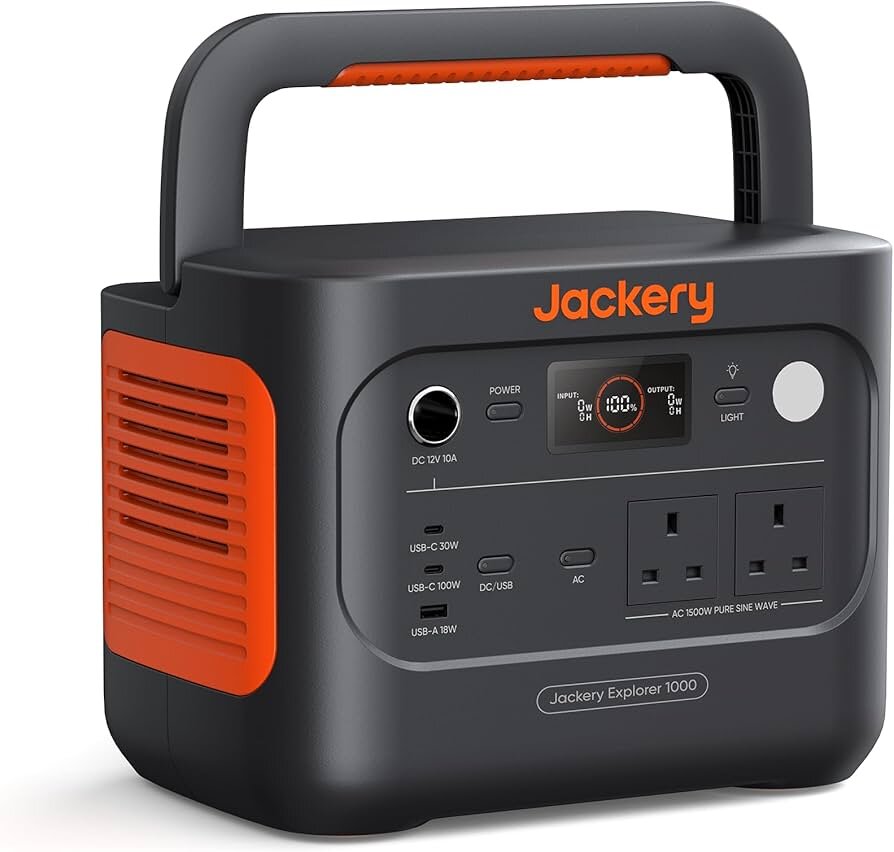
3. Jackery Explorer 1000 v2 — Best for van life and long trips
Van life pick~£429 on Amazon UK
The 1,070Wh capacity and 3,000W surge rating make this the standout pick if you are running a fridge, an induction hob, or multiple devices continuously. It handles most things a campervan might throw at it, and the 1-hour fast charge means a motorway stop restores a meaningful amount of power. For anyone doing more than occasional overnight trips, this is the unit that removes the daily anxiety about power running out.
Real camping runtimes: 12V fridge (60W) ~14hrs · Phone charges ~65 · Laptop full charges ~14 · Small induction hob ~1hr
Pros: Largest capacity in this list; 3,000W surge starts any fridge compressor; 400W solar input for van life; 4,000-cycle battery. Cons: 10.8kg — the heaviest pick; overkill for a one-night tent trip.
Check price on Amazon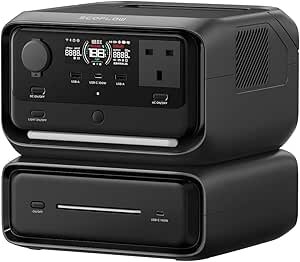
4. EcoFlow RIVER 3 Max — Best output for the money
Great value~£399 on Amazon UK
At 1,200W continuous output, this punches well above its price for campers who want to run a hair dryer, a small induction hob, or a travel kettle. Most units at this price max out at 500-600W. The 572Wh capacity is slightly smaller than the RIVER 2 Pro but the higher output more than compensates if you plan to use power-hungry devices on site. Pairs very well with a 200W solar panel for off-grid weekends.
Real camping runtimes: 12V cool box (40W) ~11hrs · Phone charges ~35 · Travel kettle (800W) ~30 boils · Laptop charges ~9
Pros: Highest output per pound in this list; runs travel kettles and hair dryers; compact. Cons: Slightly smaller capacity than RIVER 2 Pro; newer model with less long-term user data.
Check price on Amazon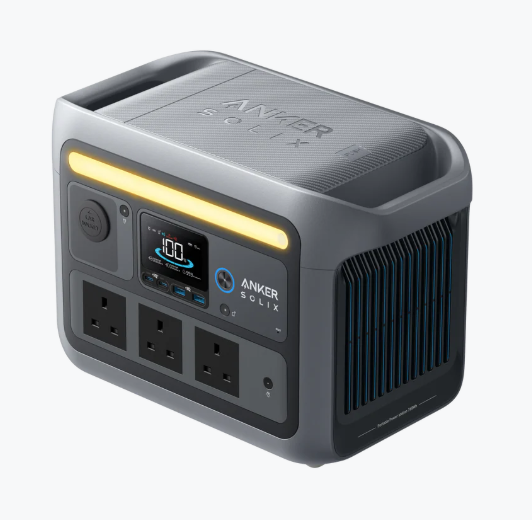
5. Anker SOLIX C800 — Best surge rating for fridges
Reliable brand~£399 on Amazon UK
The 2,400W surge rating is the highest in this list and the main reason to choose this over the RIVER 2 Pro for camping with a compressor fridge. Fridge compressors spike heavily at startup — the C800 handles that without tripping. The 43-minute fast charge (with the app enabled) is the fastest wall charge of any unit here. Anker's build quality and customer support are widely praised, and the 5-year warranty matches EcoFlow.
Real camping runtimes: 12V cool box (40W) ~15hrs · Phone charges ~45 · Laptop charges ~10 · Compressor fridge (80W) ~7hrs
Pros: Highest surge rating for fridge startup; fastest charge time in this list; excellent Anker build quality. Cons: Heavier than EcoFlow equivalent; 800W continuous is same as RIVER 2 Pro.
Check price on AmazonHow to choose: camping use case guide
Weekend tent camping
You need phones charged, a lamp, and maybe a speaker. 300-500Wh is plenty. The Jackery Explorer 500 v2 is ideal — light enough not to dominate your car boot, simple to use, and more than enough for 2 nights.
Glamping or camping with hook-up
You want to charge everything quickly between site arrivals. The EcoFlow RIVER 2 Pro wins here — its 70-minute charge means an hour plugged into the site hook-up restores a full battery.
Festival camping
No hook-up, multiple people sharing. The EcoFlow RIVER 2 Pro or Anker SOLIX C800 both offer 4 simultaneous ports and enough capacity for 2-3 days without recharging if you are sensible.
Van life / motorhome
Running a compressor fridge is non-negotiable — you need surge power and real capacity. The Jackery Explorer 1000 v2 is the pick: 3,000W surge, 1,070Wh, and 400W solar input to top up on the road.
Off-grid camping with solar
Prioritise high solar input and efficiency. The Anker SOLIX C800 accepts 300W solar, the Jackery 1000 v2 accepts 400W. Pair with a 200W panel for meaningful daily top-ups in UK summer conditions.
Cooking on site
If you want to use a travel kettle or small induction hob, you need 1,200W+ output. The EcoFlow RIVER 3 Max (1,200W) or Jackery 1000 v2 (1,500W) are the only picks here that cover it.