Best Airline-Approved Power Banks (UK 2026)
Every power bank here is airline-safe — under the 100Wh carry-on limit, so it is allowed in hand luggage on any UK flight. Below: the best flight-safe and airline-safe power banks from £19, a device-by-device capacity guide, the airline rules, and how many you can take on a plane.
ℹ Some links are affiliate links. We earn a commission if you buy through them, at no extra cost to you. Prices change frequently on Amazon — tap any Check price button to see today’s price. All available on Amazon UK with Prime delivery.
£49.99–£69.99 since 6 Sep
✈ Family trips: how many power banks do you need?
A family trip is the most power-hungry journey you’ll make. Think about what you're carrying: two phones, a couple of tablets, a Nintendo Switch, wireless earbuds, maybe a laptop. On a long-haul flight with no seat power, or a road trip through France, those devices will need at least one full charge each.
The good news: power banks are cheap, small, and multiple banks per person are allowed on planes. The key is knowing how much capacity you actually need and choosing banks that pass the airline limit without thinking about it.
🔋 Device capacity guide — how much mAh does each one need?
Use this as a quick reference. Add up the devices your family carries to work out what size bank (or how many banks) you need.
Device mAh reference guide
Note: power banks deliver roughly 65–70% of their rated capacity to devices due to conversion losses. A 10,000mAh bank delivers around 6,500–7,000mAh to your device.
✈ Common family holiday scenarios
Ryanair, easyJet to Spain
Dubai, USA, Thailand
France, Spain, Italy by car
No mains power for 3-5 days
✈ UK airline rules — what you can and can't bring
Convert mAh to Wh: Wh = (mAh × 3.7) ÷ 1000. | 10,000mAh = 37Wh | 20,000mAh = 74Wh | 24,000mAh = 88.8Wh
✈ Power bank rules by UK airline (2026)
Every UK and EU carrier follows the same IATA baseline — under 100Wh, carry-on only, never in checked luggage — but the wording and a few extras differ. Here is where the main UK airlines stand for 2026.
| Airline | Limit (no approval) | Key point for 2026 |
|---|---|---|
| British Airways | 100Wh | Keep power banks in the seat-back pocket or your under-seat bag. |
| easyJet | up to 160Wh | More generous limit; recalled batteries are banned and terminals must be protected. |
| Ryanair | 100Wh | Store in your small cabin bag under the seat in front, or on your person. |
| Jet2 | 100Wh | Banks with no visible watt-hour rating are forbidden — check the label. You also can’t use a power bank at any point during the flight. |
| TUI | 100Wh | Standard IATA rules: carry-on only, two spare banks maximum. |
The best airline-safe power banks for UK travel (2026)
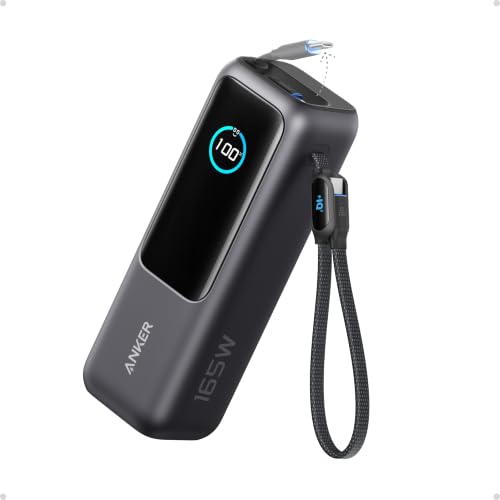
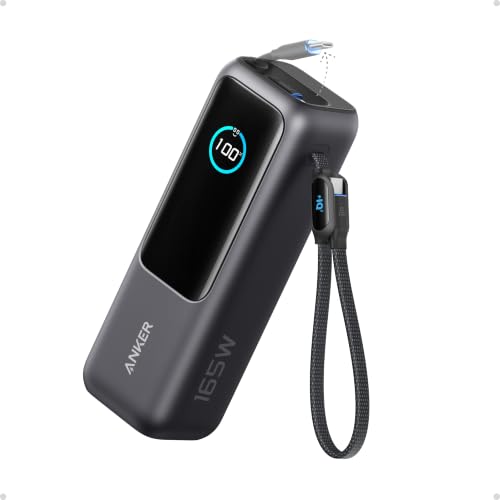
Anker 165W 25K Travel Essential
Anker’s successor to the 737 PowerCore 24K (our 737 review).
Amazon UK · about 90Wh — flight safe ✓
The best single power bank for a family trip. At 25,000mAh it will fully charge 2 phones, top up a Fire tablet, and charge the Switch — all in one bank. Anker rates each USB-C connection at up to 100W (165W across everything at once), enough for most laptops including MacBooks, so it’s genuinely useful for parents working away too.
At about 90Wh it sits under the 100Wh airline limit, and Anker sells it as flight-approved. The display shows the percentage remaining, which kids find reassuring on long flights. At 595g (Anker’s figure) it’s the heaviest here, but the capacity justifies it for families. The built-in cables mean there’s nothing to forget, and Anker quotes about 2 hours to recharge it from a 100W charger.
Family trip use: One bank shared between the whole family on a long-haul flight. Charge the tablets during dinner, top up phones overnight in the hotel, keep the Switch going on the return journey.
✓ Pros
- Charges entire family on one bank
- Up to 100W per USB-C for laptops
- Under 100Wh — flight safe
- Built-in cables, so nothing to forget
- Battery % display
× Cons
- 595g — the heaviest on this list
- Costs more than a 20K bank
- Overkill for solo travellers
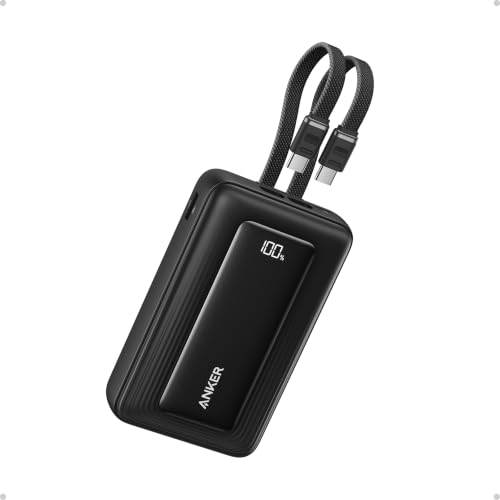
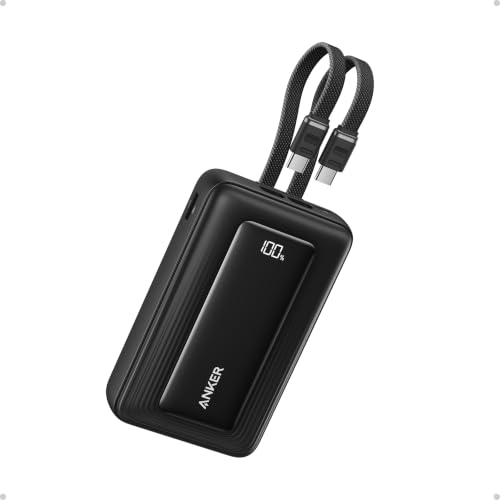
Anker 20K 45W (Dual USB-C)
Amazon UK · 72Wh — flight safe ✓
The best overall choice for most travellers. The built-in USB-C cable removes the most common holiday annoyance — "has anyone seen the charging cable?" — and 45W fast-charges any modern phone. Over 10,000 Amazon UK reviews, which tells you everything.
At just 72Wh it's effortlessly flight-safe, and light enough for teens and older kids to carry in their own bags independently. For a family of 4, buying two of these (one per adult) gives you 20,000mAh combined at £56 total — better value than the single 24K if you don't need laptop charging.
Family trip use: One per adult, tucked in a carry-on. Older kids (12+) can manage one themselves. Charge overnight, top up phones throughout the day.
✓ Pros
- Built-in USB-C cable — one less thing to pack
- 45W fast charge — 50% iPhone in 30 min
- Excellent value at £15.19
- Anker reliability and warranty
- Light enough for kids to carry
× Cons
- Built-in cable is short (5.4") — not for use while plugged in
- No Lightning cable for older iPhones
- 10K won't fully charge an iPad
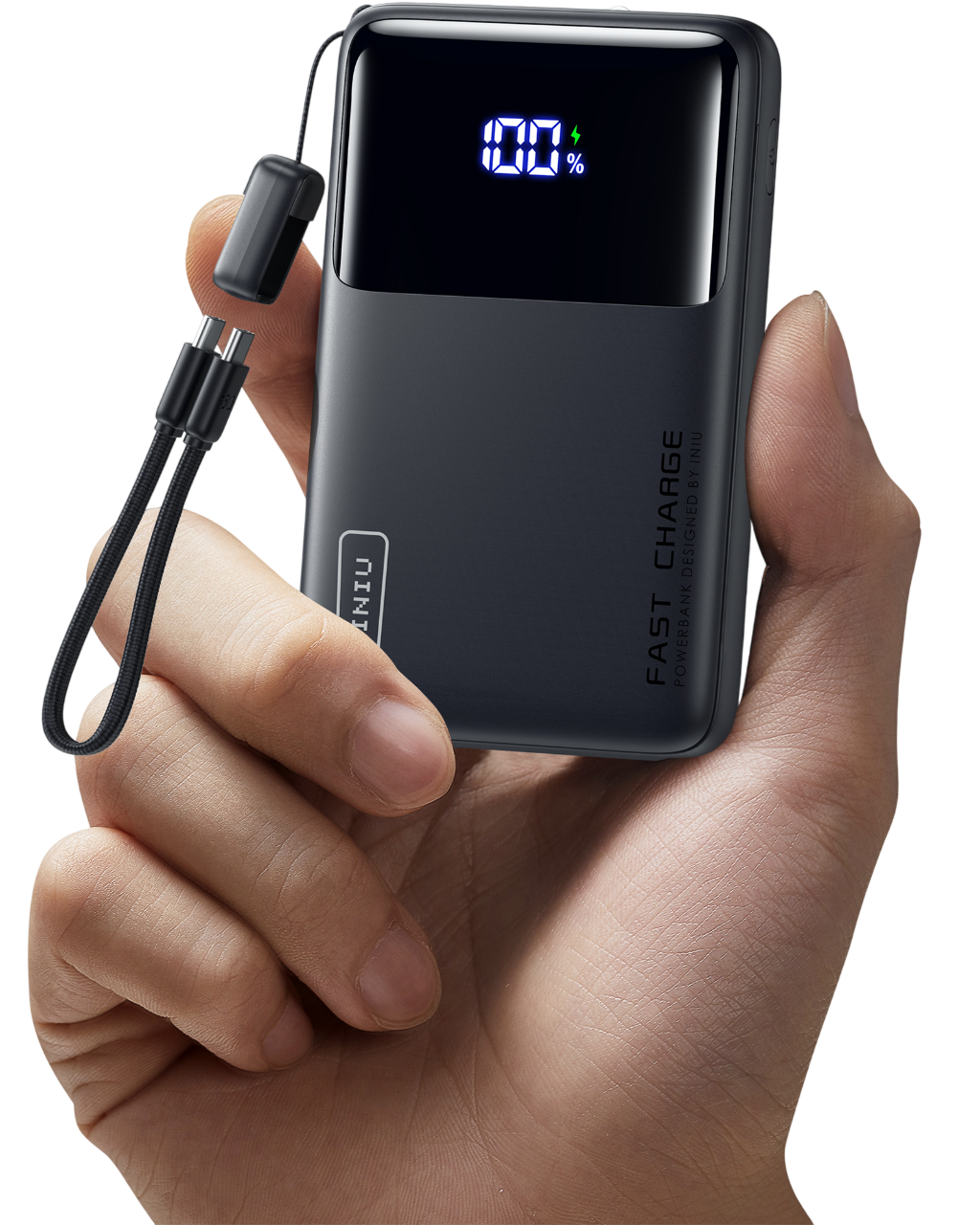
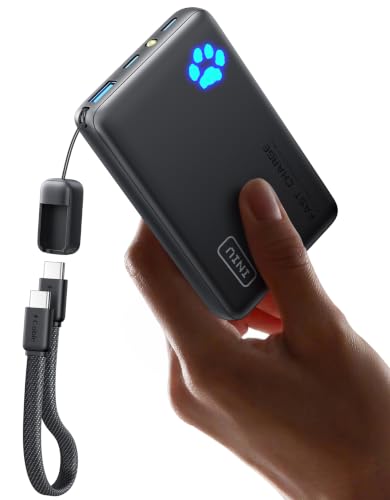
INIU 45W Ultra Slim 10K
Amazon UK · 72Wh — flight safe ✓
The most affordable flight-safe power bank worth buying. At £19.99 it charges phones at 45W — faster than many banks costing twice the price. The ultra-slim profile means it slips into a kids' bum bag or small backpack without taking up space. Over 4,200 Amazon reviews.
Family trip use: Give one to each child to manage their own devices. At £19 a piece you're not stressed about it getting lost or dropped. Works for Switch, Fire tablets, and phones.
✓ Pros
- Best value at £19.99
- 45W — faster than most rivals
- Ultra-slim, light (180g)
- Kids can easily manage it themselves
× Cons
- No built-in cable — need to pack one
- Single USB-C port (one device at a time)
Belkin BoostCharge Plus 10K
Amazon UK · 72Wh — flight safe ✓
The only power bank on this list with both built-in USB-C and Lightning cables — perfect for families still on older iPhones or iPads with Lightning ports. No cable hunting, no adapters, no arguments about who has the right cable.
Family trip use: The family bank where everyone just plugs in whatever they have. Especially useful if kids have older iPads or if one parent is still on Lightning.
✓ Pros
- Built-in USB-C AND Lightning cables
- USB-A port for a third device
- Belkin quality and reliability
- No cable sorting at the airport
× Cons
- 23W is slower than rivals
- Lightning less relevant as Apple moves to USB-C
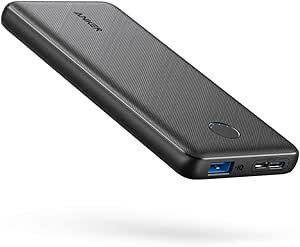
Anker PowerCore Slim 10K PD
Amazon UK · 72Wh — flight safe ✓
Anker's most-reviewed travel power bank with over 18,000 Amazon UK reviews. At 18W it charges phones and the Nintendo Switch, at 190g it's light enough for smaller kids to carry, and at a low price it's low-risk to hand to a child. Slim, reliable, and proven.
✓ Pros
- 18,000+ reviews — market-proven reliability
- Slim card-style profile
- Charges Nintendo Switch
- Light enough for younger kids
× Cons
- 18W is slower than newer rivals
- No built-in cable
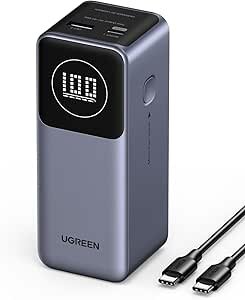
UGREEN Nexode 12000 100W
Amazon UK · 44.4Wh — flight safe ✓
The best option if you need to top up a laptop on a flight without carrying a massive bank. 100W charges most MacBooks at near-full speed; the 12,000mAh won't fully charge a laptop but will extend it by 20-30%. At 44.4Wh it's well under the airline limit.
✓ Pros
- 100W — charges MacBooks and laptops
- Compact for a 100W bank
- Two USB-C ports simultaneously
- Well under airline limit
× Cons
- 12,000mAh won't fully charge a laptop
- More expensive than comparable 10K banks
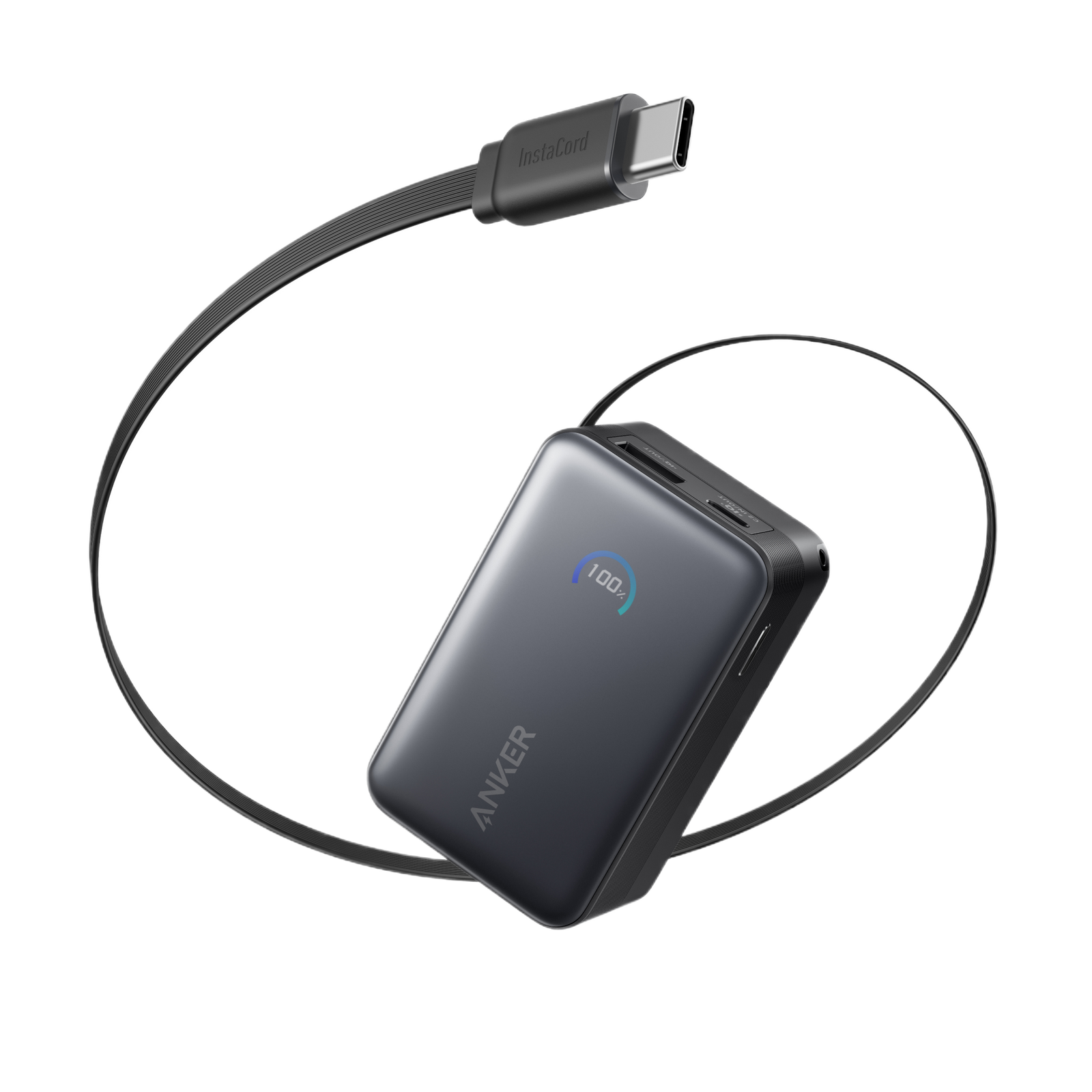
Anker Nano 10K 45W
£49.99 · Amazon UK · 72Wh — flight safe ✓
The most polished travel power bank on this list. The retractable built-in cable is genuinely clever — no fumbling in a dark airport lounge, nothing to lose, and it stows perfectly. 45W charges an iPhone 16 to 50% in about 27 minutes. The smart display shows exact percentage remaining.
✓ Pros
- Retractable USB-C cable — the best built-in design
- 45W fast charge
- Smart % display
- Charge 2 devices at once
× Cons
- £72.65 — among the priciest 10K banks on the list
- Retractable cable USB-C only
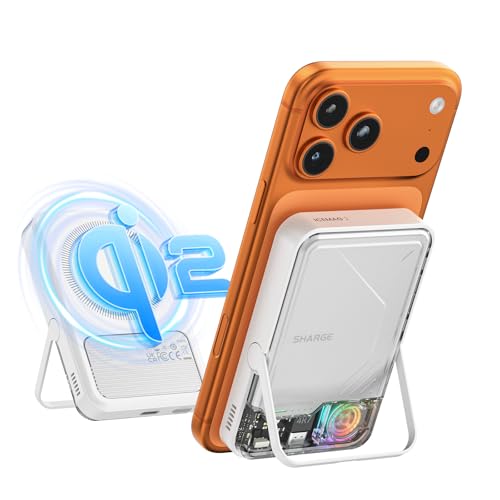
SHARGE IceMag 2
Amazon UK · 22.2Wh — flight safe ✓
Magnetically snaps to the back of any MagSafe or Qi2 iPhone and charges at 15W without a cable. The slimmest option on the list at around 180g. 6,000mAh charges an iPhone 15 roughly 1.5 times. Perfect for the parent who hates cables but has an iPhone 13 or later.
✓ Pros
- MagSafe/Qi2 — no cable needed
- Snaps to phone, use one-handed
- Very light at ~180g
- 15W — fastest wireless charging
× Cons
- iPhone MagSafe only (not for kids' Android devices)
- 6,000mAh is limited for a long flight
- More expensive per mAh than wired banks
Full comparison table
| Model | mAh | Wh | Output | Cable | Weight | Best for |
|---|---|---|---|---|---|---|
| Anker 165W 25K | 25,000 | ~90Wh | 165W max | Built-in USB-C | 595g | Families, MacBooks |
| Anker 20K 45W | 20,000 | 72Wh | 45W | 2× USB-C built-in | ~220g | Adults, teens |
| INIU 45W Ultra Slim | 10,000 | 37Wh | 45W | No | ~180g | Kids, budget |
| Belkin BoostCharge Plus | 10,000 | 37Wh | 23W | USB-C + Lightning | ~230g | Mixed Apple households |
| Anker PowerCore Slim 10K | 10,000 | 37Wh | 18W | No | ~190g | Kids, Nintendo Switch |
| UGREEN Nexode 12000 | 12,000 | 44.4Wh | 100W | No | ~280g | Laptop top-ups |
| Anker Nano 10K 45W | 10,000 | 37Wh | 45W | Retractable USB-C | 232g | Premium travel |
| SHARGE IceMag 2 | ~6,000 | 22.2Wh | 15W wireless | No (magnetic) | ~180g | iPhone MagSafe |
All picks are under 100Wh and flight-safe. Prices change frequently on Amazon — tap any Check price button to see today’s price. All available on Amazon UK with Prime delivery.
Buying guide: what to look for
How much capacity do you actually need?
The single most important decision. As a rule of thumb: every 10,000mAh charges 2-3 smartphones or 1 Nintendo Switch twice. Power banks deliver around 65-70% of their rated capacity to devices due to conversion losses, so a 10,000mAh bank delivers ~6,500-7,000mAh to your phone.
For a family holiday the simplest approach is: one 10,000mAh bank per adult, plus one shared 24,000mAh bank in the family bag for tablets and the Switch. That gives you plenty of redundancy.
Output wattage — why it matters for kids' devices
18W is the minimum worth considering — it charges any phone and the Nintendo Switch. 30W fast-charges most phones. 45W fast-charges iPhones and charges MacBook Airs (slowly). 100W+ charges MacBook Pros properly. For kids' devices (Fire tablets, Switch, phones), 18-30W is all you need.
Built-in cables — worth it for families?
Yes, strongly recommended for family travel. Built-in cables mean fewer cables to pack, fewer cables to lose, and no arguments about who has the right adapter. The Anker 20K 45W (two built-in USB-C cables) and Belkin BoostCharge Plus (USB-C + Lightning) are the best options here.
How many power banks per person on a plane?
Most airlines allow a maximum of 2 spare power banks per person in hand luggage. You can carry as many charged devices as you like (phones, tablets, laptops). A family of 4 can carry up to 8 power banks total — far more than anyone actually needs. The key rule: all power banks in hand luggage, never checked bags.
UK airline power bank rules at a glance
Every UK airline follows the same CAA/ICAO framework: power banks travel in cabin baggage only, never the hold. Under 100Wh needs no approval; 100–160Wh needs the airline’s OK; over 160Wh is banned from passenger aircraft.
| Airline | Cabin bag | Hold bag | ≤100Wh | 100–160Wh |
|---|---|---|---|---|
| British Airways | ✓ Yes | ✗ No | Allowed | Airline approval required |
| easyJet | ✓ Yes | ✗ No | Allowed | Airline approval required |
| Ryanair | ✓ Yes | ✗ No | Allowed | Airline approval required |
| Jet2 | ✓ Yes | ✗ No | Allowed | Airline approval required |
| TUI Airways | ✓ Yes | ✗ No | Allowed | Airline approval required |
| Virgin Atlantic | ✓ Yes | ✗ No | Allowed | Airline approval required |
Practical translation: every pick on this page is under 100Wh, so it flies with any UK airline without paperwork. Keep banks where they will not be crushed, note ICAO’s spare-battery limits if you carry several, and since airlines add detail from time to time (some ask you to keep banks in sight during use rather than in overhead lockers), a 30-second check of your airline’s dangerous goods page before flying is always worth it.
Frequently asked questions