Best Portable Power Stations Under £500 (UK 2026)
Six value picks for UK power cuts — covering Wi‑Fi, phones, laptops and more. With estimated runtimes and who each one actually suits. How we choose
Affiliate disclosure: Some links on this page are affiliate links. If you buy through them we may earn a small commission at no extra cost to you. This doesn't affect which products we recommend.
Quick picks at a glance
| Model | Capacity | Max output | Battery | Best for | £ per 100Wh | Link |
|---|---|---|---|---|---|---|
| Jackery Explorer 500 v2 | 512 Wh | 500W / 1000W surge | LiFePO4 | Lightest (5.7kg) | – | £339 on Amazon UK |
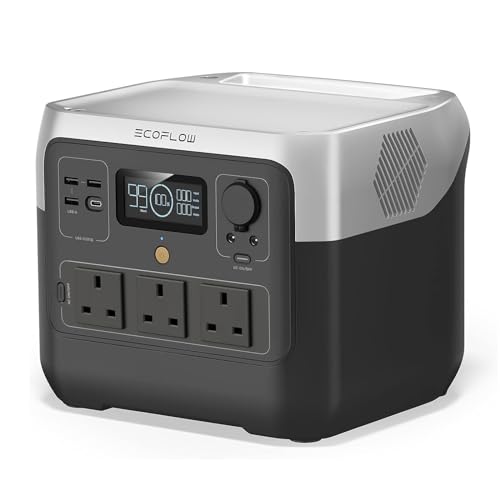
| EcoFlow RIVER 2 Pro | 768 Wh | 800W / 1600W (X-Boost) | LiFePO4 | Balanced all-rounder | – | £499 on Amazon UK |
| EcoFlow RIVER 3 Max | 572 Wh | 600W / 1,200W X-Boost | LiFePO4 | Lowest price; 10ms UPS | – | Check price on Amazon UK |
| Jackery Explorer 1000 v2 | 1070 Wh | 1500W / 3000W surge | LiFePO4 | Most capacity; fridges | – | £398 on Amazon UK |
| Anker SOLIX C1000 Gen 2 | 1,024Wh | 2,000W / 3,000W peak | LiFePO4 | Highest output | – | £474 on Amazon UK |
| Bluetti AC70 | 768 Wh | 1000W / 2000W (Power Lifting) | LiFePO4 | Expandable; 500W solar | – | £399 on Amazon UK |
£ per 100Wh is worked out live from today’s price. Lower is better value for stored energy, but it ignores output, surge and features — use it alongside the notes below.
Prices change frequently on Amazon — tap any Check price button to see today’s price. All available on Amazon UK with Prime delivery.
What to realistically expect under £500
Under £500 you can get a genuinely capable backup power station — enough to keep the essentials running through most UK power cuts, which typically last under 4 hours.
Comfortably covered: Wi‑Fi router + ONT, smartphones, laptops, LED lights, fans, CPAP machines.
Possible with the right pick: small fridge for a few hours (needs a high surge rating — the Jackery 1000 v2 and Anker SOLIX C1000 Gen 2 are the safest here).
Not realistic: kettles, electric heaters, hair dryers, electric ovens, or running a fridge for 12+ hours.
500Wh → ~21 hrs
500Wh → ~9 hrs
500Wh → ~3.5 hrs
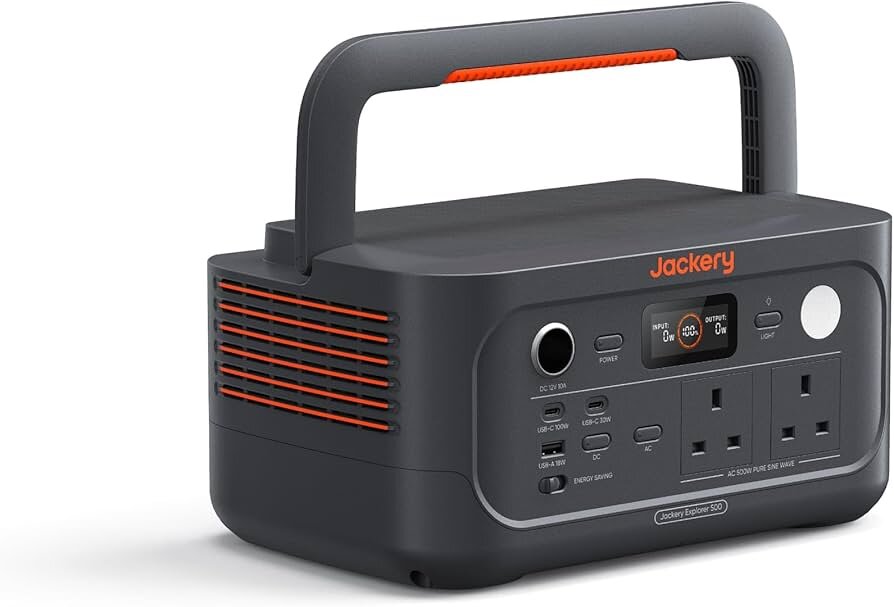
1. Jackery Explorer 500 v2 — Lightest pick
Best budgetThe Explorer 500 v2 is the easiest entry point into backup power. At 512Wh with a pure sine wave inverter and LiFePO4 chemistry, it punches well above its price. The 500W continuous output won't run a fridge reliably, but for Wi‑Fi, phones and a laptop it's hard to beat for the money.
Pros: Affordable, compact, LFP battery rated 4000 cycles, fast wall recharge, pure sine wave. Cons: 500W continuous limits fridge use; no solar pass-through charging.
£339 on Amazon UK£329–£339 since 6 Sep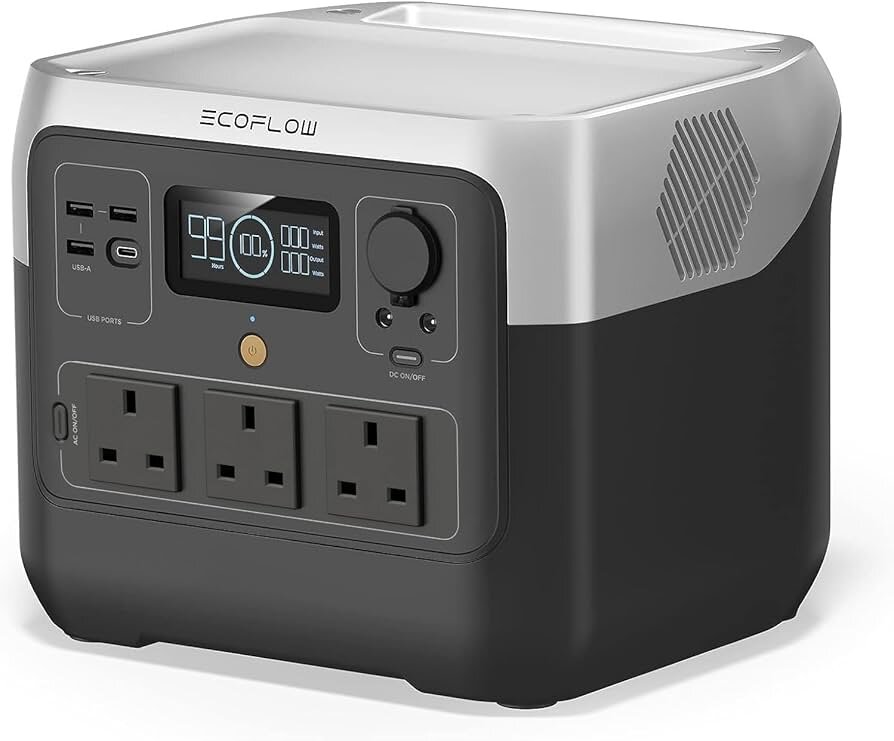
2. EcoFlow RIVER 2 Pro — Balanced all-rounder
Top pickThe RIVER 2 Pro is consistently one of the best-value power stations on the UK market. 768Wh capacity, 800W output that stretches to 1600W via EcoFlow's X-Boost technology (which intelligently boosts underpowered appliances), and a full recharge from the wall in about 70 minutes. A strong choice if you want more capacity than the RIVER 3 Max without stepping up to a 1kWh unit.
Pros: X-Boost allows running appliances above rated output, ultra-fast recharge, solid app, 3000-cycle LFP. Cons: X-Boost has limits — won't genuinely replace high-output appliances, just works around them.
£499 on Amazon UK£329–£499 since 6 Sep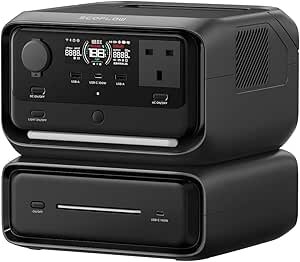
3. EcoFlow RIVER 3 Max — Best for most homes
Great valueThe RIVER 3 Max is our pick for most homes: 572Wh and a 10ms UPS switchover in a compact unit, with 600W continuous output (1,200W via X-Boost) — a little more capacity and output than the entry-level Jackery. 572Wh capacity is solid for a cut of several hours.
Pros: 10ms UPS switchover, more capacity than the Jackery 500 v2, X-Boost to 1,200W, compact. Cons: 600W continuous is modest for power-hungry appliances; smaller battery than the RIVER 2 Pro.
Check price on Amazon UKOut of stock on Amazon UK right now. In stock instead: EcoFlow RIVER 2 Pro, 768Wh, a bigger battery – £499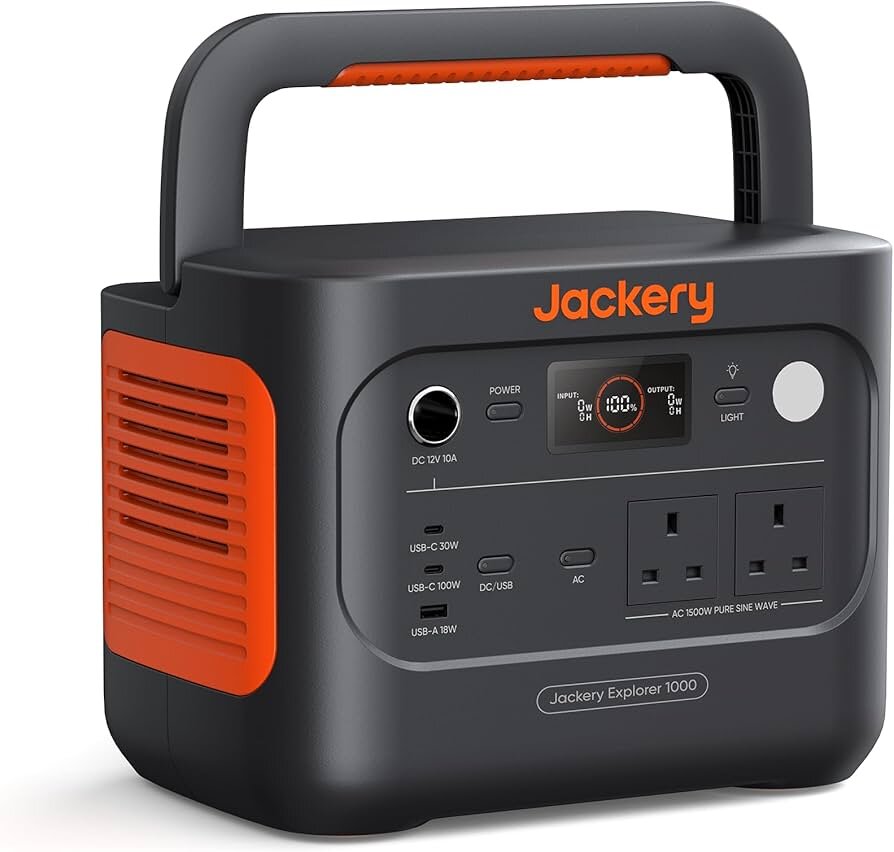
4. Jackery Explorer 1000 v2 — Most capacity under £500
Highest capacityAt 1070Wh, the Explorer 1000 v2 is the biggest battery here (its price moves around, so check the live button). Combined with 1500W output and a 3000W surge, this is the pick if you want a genuine shot at keeping a fridge running for 6+ hours, or powering several devices simultaneously overnight.
Pros: Best-in-class capacity at this price point, high surge for fridges, good solar input. Cons: 10.8kg is a proper carry; only 2 AC sockets.
£398 on Amazon UK£379–£499 since 6 Sep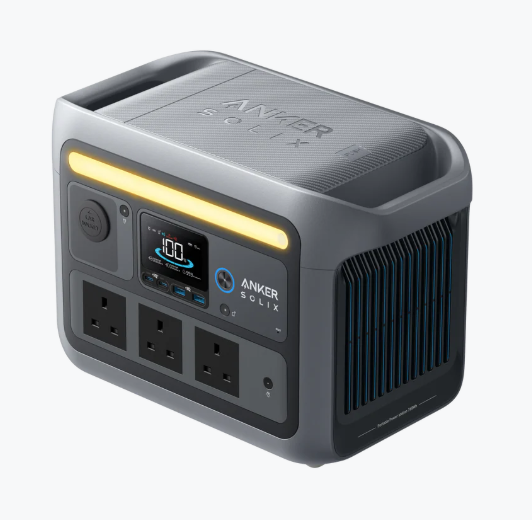
5. Anker SOLIX C1000 Gen 2 — Highest output
Reliable brandAnker's SOLIX C1000 Gen 2 brings the brand's trademark build quality to the power station market. 1,024Wh, 2,000W continuous and a 3,000W peak make it the most powerful unit here, and a strong contender for fridge duty. Anker's customer support and warranty reputation also makes it a lower-risk buy.
Pros: Highest continuous output and peak here, 1kWh capacity, very fast recharge, Anker build quality and support. Cons: Heaviest pick at 11.3kg; sits at the top of the budget.
£474 on Amazon UK£450–£599 since 6 Sep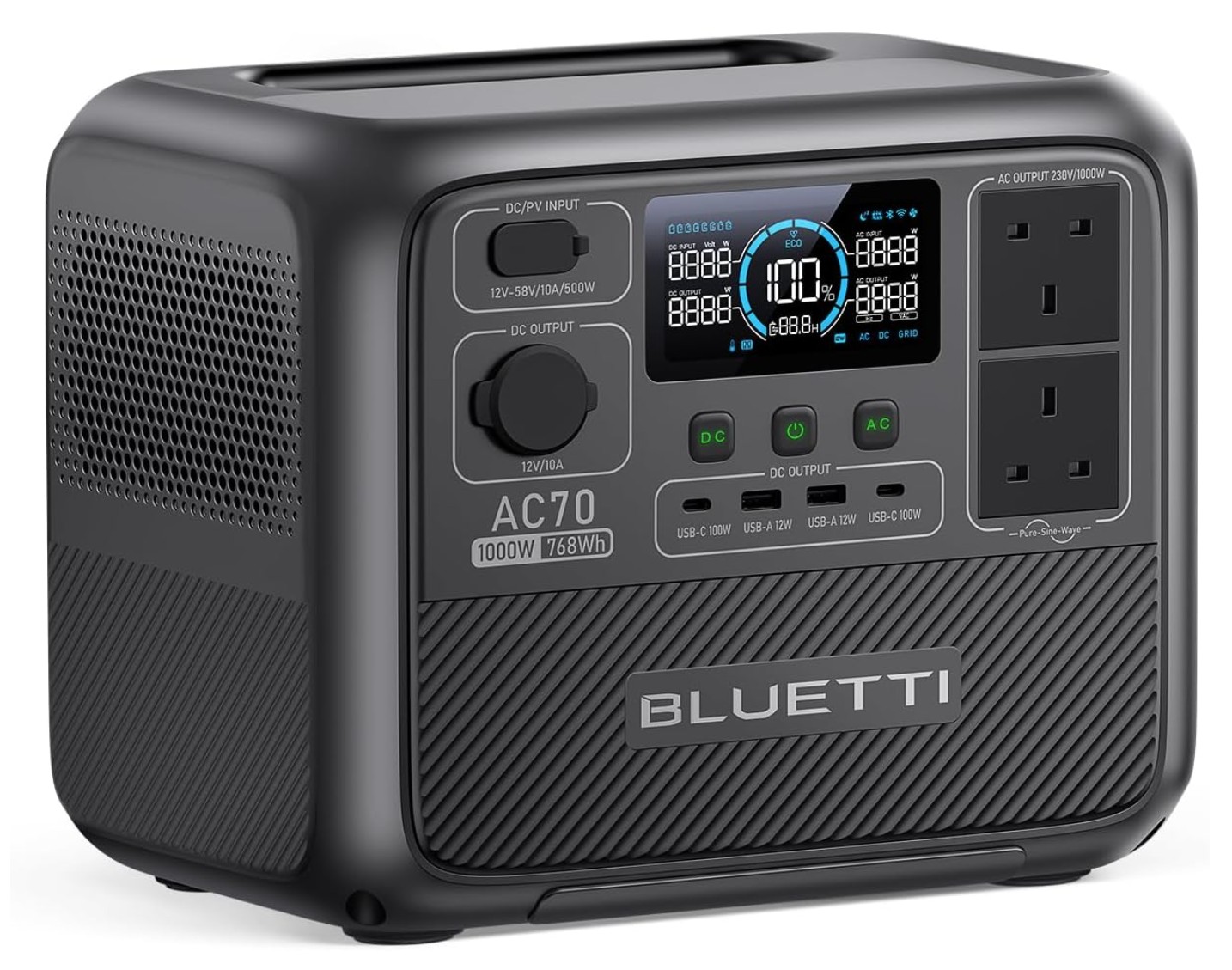
6. Bluetti AC70 — Expandable pick
1,000W outputThe AC70 brings 1,000W of continuous output as standard, rising to 2,000W via Bluetti’s Power Lifting mode. That makes it capable with demanding devices like a travel hairdryer or electric blanket (Power Lifting runs heating appliances at reduced power), and it takes up to 500W of solar. At 768Wh it matches the EcoFlow RIVER 2 Pro on capacity, but with more power and a faster 45-minute charge to 80%.
Pros: 1,000W continuous; up to 500W solar; Power Lifting handles hairdryers and travel kettles; fast 45-min to 80% charge; expandable with B80 battery; solid app. Cons: 10.2kg; 2 AC outlets only.
£399 on Amazon UK↓ £100 under its usual price£381.65–£499 since 6 Sep
How to choose the right one
1. Start with what you actually need to power
Make a list of devices you'd want running in a power cut. Router + ONT (~20W), a laptop (~45W) and phone charging (~10W) adds up to roughly 75W — a 500Wh unit covers that for 5+ hours. If you add a fridge (variable, but plan for 120W average), your numbers change significantly.
2. Capacity (Wh) vs output (watts) — both matter
Capacity (Wh) is how much energy is stored — think of it as the size of your fuel tank. Output (watts) is how much it can deliver at once — think of it as the engine. You need enough of both. A 1000Wh unit with only 300W output won't run a fridge even if the tank is big enough, because the engine isn't powerful enough to start it.
3. Surge rating is key for fridges
Fridge compressors draw 3–6× their running watts for a split second on startup. If the power station's surge rating can't handle this, the unit will trip or shut off. For fridge use, prioritise units with 1,500W+ surge — the Jackery 1000 v2 (3,000W surge) and Anker SOLIX C1000 Gen 2 (3,000W peak) are the safest bets here.
4. Battery chemistry: LiFePO4 is worth it
All six picks in this guide use LiFePO4 (LFP) batteries, which is the right choice for home backup. LFP is thermally stable (no fire risk that older lithium chemistries carried), has a longer cycle life (2000–4000 cycles vs ~500 for older NMC), and holds charge better over time. If a unit you're considering uses NMC chemistry, factor that into the decision.
5. Recharge speed matters more than you might think
After a power cut, you want to get your backup charged again quickly. Most picks here recharge from the wall in roughly 45–90 minutes: the Anker C1000 Gen 2 and Jackery 1000 v2 are quickest in their fast modes, and the RIVER 2 Pro and Jackery 500 v2 take about 70 minutes. If you're in an area with frequent shorter cuts, faster recharge is more valuable than raw capacity.
What not to buy under £500
- Capacity quoted in mAh. Power stations should state Wh. A cheap listing leading with “60,000mAh” is usually a small battery.
- Modified or “quasi” sine wave inverters. Stick to pure sine wave for fridges, CPAP machines and anything with a motor.
- A “boost” figure bought as real output. X-Boost and Power Lifting lower the voltage so heating appliances run slower instead of tripping. They don’t turn a 600W unit into a 1,200W one.
- Older NMC batteries. Every pick here is LiFePO4, typically rated for thousands of cycles.
Only need the Wi-Fi to stay up? A router UPS from around £55 may be all you need — see our router backup picks. Comparing with a generator? See our main guide.