Power station sizing: Wh vs watts (UK)
Two numbers matter: Wh (how long it lasts) and W (what it can run). Here’s how to size without overpaying.
- Wh = stored energy (runtime)
- W = output power (what you can run at once)
- Planning: usable Wh is often ~80–90% of the label
Jump to what you need
3 common sizing scenarios
PCRUse these as a starting point, then plug your real numbers into the formula.
Buying a power station and confused by the specs? You are not alone.
This guide explains the two numbers that actually matter — Wh (watt-hours) and W (watts) — so you can pick the right size without overspending.
The short version
- Wh (watt-hours) = how much energy is stored (like the size of a fuel tank)
- W (watts) = how fast energy flows out (like the width of the fuel pipe)
You need enough Wh to last the duration, and enough W to run your devices without tripping.
Wh (watt-hours): how long it lasts
Watt-hours tell you total capacity.
Simple formula:
Runtime (hours) ≈ (Wh × 0.8) ÷ device watts
The 0.8 accounts for inverter losses (energy lost as heat).
Wh also decides what you can fly with: airlines cap power banks at 100Wh (around 27,000mAh) in hand luggage. If you are travelling light rather than carrying a power station, see our guide to airline-safe power banks — every pick stays under that limit.
Example
- Power station: 500Wh
- Router: 15W
Runtime ≈ (500 × 0.8) ÷ 15 = 26 hours
Quick reference (approximate runtimes from 500Wh)
| Device | Watts (typ.) | Runtime (rough) |
|---|---|---|
| Wi‑Fi router | 10–15W | 25–40 hours |
| Phone charging | 10–20W | 20–40 charges |
| Laptop | 30–60W | 6–13 hours |
| LED lamp | 5–10W | 40–80 hours |
| Mini fridge | 50–80W avg | 5–8 hours |
W (watts): what you can run
Watts tell you the maximum load the power station can handle at once.
Look for two ratings: - Continuous (or rated) watts — what it can run steadily - Surge (or peak) watts — short bursts for startup spikes
Why surge matters
Some devices (fridges, power tools) draw a big spike when they start. If your power station cannot handle the surge, it trips — even if the battery is full.
Rule of thumb for fridges: - Running: 50–150W - Startup surge: 3–7× that (so 150–1000W briefly)
If you want to run a fridge, aim for 1000W+ continuous and 2000W+ surge.
Common mistakes
1. Buying on Wh alone
A 1000Wh station with only 300W output will not run a fridge. Capacity is not everything.
2. Ignoring inverter efficiency
You never get 100% of the rated Wh. Expect 80–90%. Budget accordingly.
3. Running too many things at once
Adding devices adds watts. A router (15W) + laptop (50W) + lamp (10W) = 75W. Fine on most stations. Add a kettle (2000W)? Good luck.
How to size for your setup
Step 1: List your devices
Write down what you want to run and their wattage. (Check the label or manual.)
Step 2: Add up the watts
Total watts = what continuous output you need.
Step 3: Estimate runtime
Decide how many hours you need backup for, then:
Wh needed ≈ (total watts × hours) ÷ 0.8
Example
- Router (15W) + lamp (10W) + phone charging (15W) = 40W
- Want 12 hours runtime
- Wh needed ≈ (40 × 12) ÷ 0.8 = 600Wh
A 500–700Wh power station would be a sensible choice. The EcoFlow RIVER 2 Pro£329–£499 since 6 Sep (768Wh, £499) sits right in that bracket and charges in 70 minutes — useful if you want to top it up fast before a forecast outage. On a tighter budget the Jackery Explorer 500 v2£329–£339 since 6 Sep (512Wh) covers the same scenario with a bit less headroom.
Quick sizing guide
| Use case | Min capacity | Min output |
|---|---|---|
| Router + phones + lights (overnight) | 300–500Wh | 200W |
| Above + laptop (full day) | 500–800Wh | 300W |
| Above + mini fridge (sometimes) | 1000Wh+ | 1000W (aim ~2000W surge) |
Some links on this page are affiliate links. This means we may earn a commission if you buy through them, at no extra cost to you.
Ready to buy? Match your size to these picks
PCR pickNow you know what capacity you need - here are the best options at each size bracket, all available on Amazon UK.
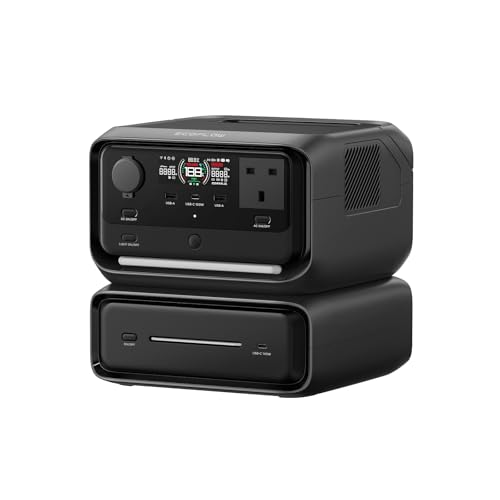
Runs router, lights and phone charging through a long outage, with a 10ms UPS switchover. Our value pick — tap for today’s price.
Out of stock on Amazon UK right now. In stock instead: EcoFlow RIVER 2 Pro, 768Wh, a bigger battery – £499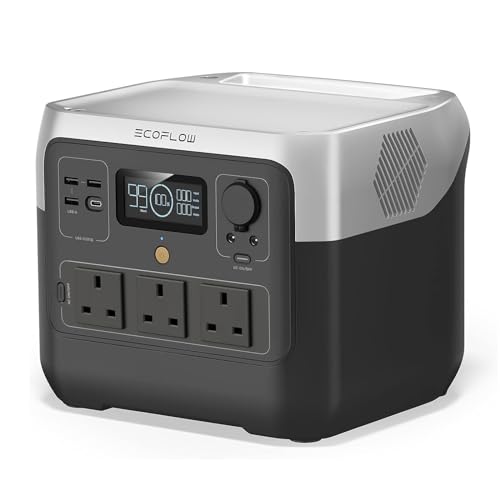
The sweet spot for most homes. Runs a fridge for 4-5 hrs, router for 15+ hrs, or keep lights and phones topped up all night.
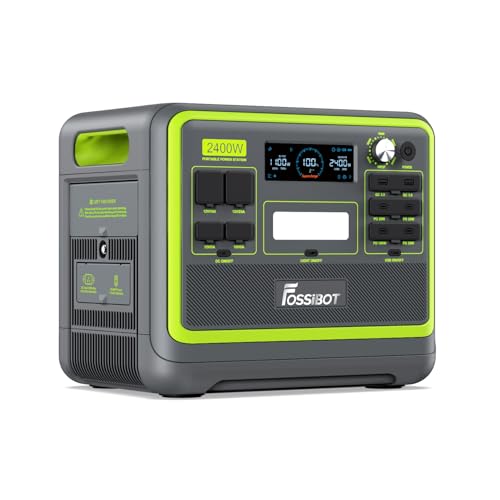
For serious outages. 2kWh covers fridge, freezer, router, TV and charging all night. Best value large-capacity option.
Prices change frequently on Amazon — tap any Check price button to see today’s price. All available on Amazon UK with Prime delivery.
Common device wattages: UK reference table
Use this as a starting point. Actual wattage varies by model — check the label on the plug or in the device manual for your specific appliance.
| Device | Typical watts (running) | Notes |
|---|---|---|
| Wi-Fi router | 5–20W | Most modern routers are 10–15W |
| Laptop (charging) | 30–100W | Depends on size; MacBook ~30W, gaming laptop ~100W+ |
| Phone (charging) | 5–25W | Fast chargers use more; slower once near full |
| LED lamp (bulb) | 5–15W | Replace old halogens — huge efficiency gain |
| LED strip lights | 10–30W | Depends on length |
| Smart TV (40–55") | 50–100W | OLED uses slightly more than LCD |
| Fridge-freezer | 50–150W | Running average; startup surge 3–6× higher |
| Gas boiler (pump + controls) | 100–200W | Varies by model; check manual |
| CPAP machine | 30–60W | Without humidifier; with humidifier up to 100W |
| Mini fridge | 30–80W | Much easier to run than full fridge-freezer |
| Electric blanket | 60–100W | Good alternative to space heater |
| Kettle | 2,000–3,000W | Too high for most power stations under 2kW |
| Microwave | 700–1,500W | Borderline — check your power station's rated output |
| Hair dryer | 1,200–2,400W | Almost certainly too high; use a travel dryer if needed |
What you cannot run on most portable power stations
Some appliances draw more power than any affordable portable power station can deliver. Knowing what is off the table helps you plan realistically:
- Electric kettle — 2,000–3,000W. Not possible on anything under a 3kWh unit.
- Electric shower — 7,000–10,800W. Far beyond portable power station territory.
- Washing machine — 2,000W+ on a hot wash. Cold wash sometimes possible on high-output units.
- Tumble dryer — 2,000–5,000W. Not practical.
- Storage heaters / electric radiators — 500–2,000W each. Can drain a large battery in an hour.
The workarounds: use a camping stove for hot drinks, wear extra layers instead of heating, and accept that some luxuries are just grid-dependent.
How battery capacity degrades over time
All lithium batteries lose a small amount of capacity with each charge cycle. The key metric is the battery chemistry:
- LFP (LiFePO4) — used in all current Jackery and EcoFlow models. Rated for 3,000–4,000 cycles to 80% capacity. At one full cycle per week, that is 60–80 years of use. Effectively lifetime batteries for home use.
- NMC (older chemistry) — rated for around 500 cycles. Now largely obsolete in the consumer power station market but still found in some cheap units.
For sizing purposes: assume your power station retains full rated capacity for at least 5–10 years of normal home use. The 80% runtime multiplier in our formula accounts for inverter losses, not battery degradation.
Sizing for solar top-up
If you plan to pair your power station with a solar panel for extended off-grid use or as a way to recharge during a long outage, the solar panel wattage determines how quickly you can replenish the battery.
UK solar reality check: in summer, a south-facing 100W panel in good conditions might deliver 400–500Wh per day. In winter or overcast weather, expect 50–150Wh per day. Solar is a useful supplement in summer but should not be your primary recharge strategy for winter power cuts.
Rule of thumb: match your solar panel wattage to at least 20% of your battery capacity to get a meaningful daily top-up. A 500Wh battery pairs well with a 100W panel; a 1,000Wh battery benefits from a 200W panel.
FAQ
PCRQuick answers to common questions.