Best Portable Power Stations for UK Power Cuts (2026 Guide)
Six picks across all budgets — from entry-level Wi‑Fi backup to whole-home power. Honest runtimes, clear comparisons and no marketing fluff.
Affiliate disclosure: Some links on this page are affiliate links. We may earn a small commission if you buy through them, at no extra cost to you. This doesn't influence our recommendations.
Quick comparison
PCR| Model | Capacity | Output | Surge | Weight | Best for | Link |
|---|---|---|---|---|---|---|
| Jackery Explorer 500 v2 | 512 Wh | 500W | 1000W | 6.4 kg | Budget pick | Buy |
| EcoFlow RIVER 2 Pro | 768 Wh | 800W | 1600W | 7.8 kg | Best overall | Buy |
| EcoFlow RIVER 3 Max | 572 Wh | 1200W | 1500W | 8.0 kg | High output under £300 | Buy |
| Jackery Explorer 1000 v2 | 1070 Wh | 1500W | 3000W | 10.4 kg | Best for fridges | Buy |
| Anker SOLIX C800 | 768 Wh | 800W | 2400W | 9.1 kg | Best Anker / high surge | Buy |
| FOSSiBOT F2400 | 2048 Wh | 2400W | 4800W | 27.0 kg | Whole-home backup | Buy |
Prices vary — always check Amazon for current pricing. All available on Amazon UK with Prime delivery.
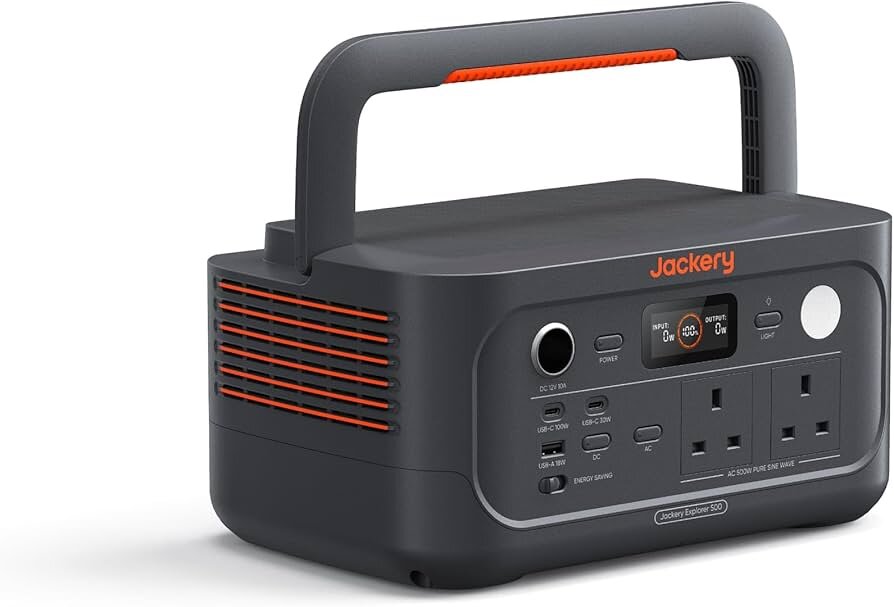
1. Jackery Explorer 500 v2 — Best budget pick
Best budgetThe Explorer 500 v2 is the clearest entry point into backup power for most UK homes. At 512Wh with pure sine wave output, LiFePO4 chemistry and a quiet fan profile, it's compact enough to store in a cupboard and pull out when needed. The 500W output limits it — you won't reliably start a fridge compressor — but for Wi‑Fi, phones, a laptop and LED lighting through most UK power cuts, it's hard to beat for the money.
Pros: Compact and lightweight, pure sine wave, LFP battery rated 4000 cycles, fast USB-C, quiet.
Cons: 500W continuous limits fridge use; no pass-through charging; no app connectivity.
View on Amazon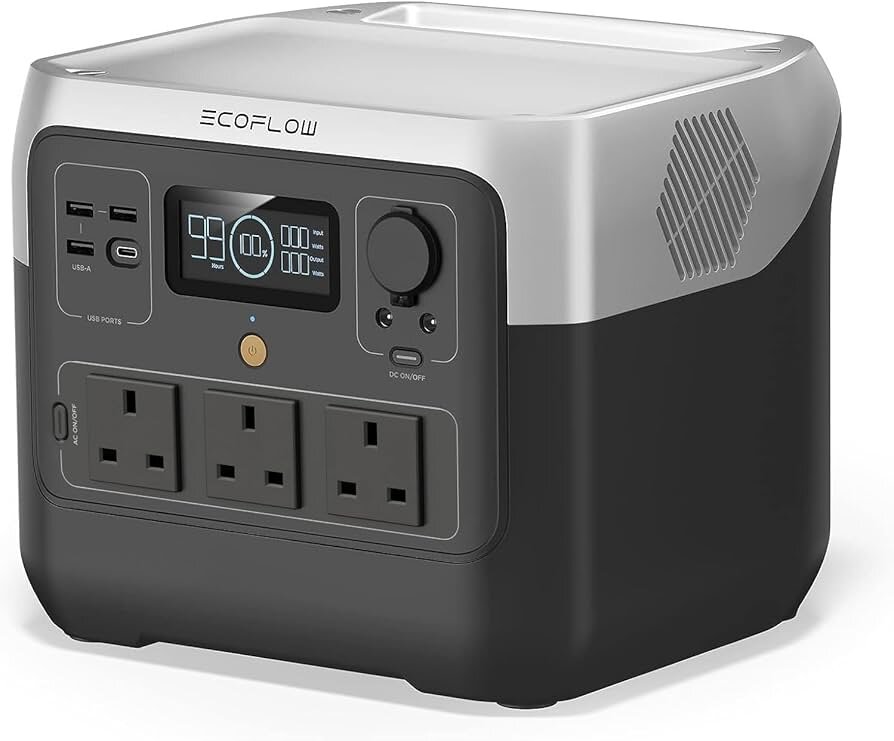
2. EcoFlow RIVER 2 Pro — Best overall
Top pickThe RIVER 2 Pro is consistently one of the strongest all-round power stations on the UK market. The 768Wh capacity comfortably handles a full power cut, the sub-60-minute wall recharge is class-leading, and EcoFlow's X-Boost technology intelligently steps up power to appliances that slightly exceed the rated 800W output. It's our first recommendation for most UK households.
Pros: Fastest wall recharge in this list, X-Boost for borderline appliances, solid EcoFlow app, 3000-cycle LFP.
Cons: X-Boost doesn't genuinely raise output to 1600W — it manages power intelligently; 800W won't start a large fridge compressor.
View on Amazon
3. EcoFlow RIVER 3 Max — Best high output under £300
Great valueWhere most sub-£300 units top out at 500–600W, the RIVER 3 Max delivers 1200W continuously with 1500W surge. That extra headroom means it can handle more appliances simultaneously and has a better chance of starting a compact fridge compressor. At 572Wh the tank is slightly smaller than the RIVER 2 Pro, but the output-to-price ratio is strong.
Pros: 1200W continuous is high for the price, compact, good surge for small fridges.
Cons: Newer model with less long-term user data; slightly smaller capacity than RIVER 2 Pro for slightly less money.
View on Amazon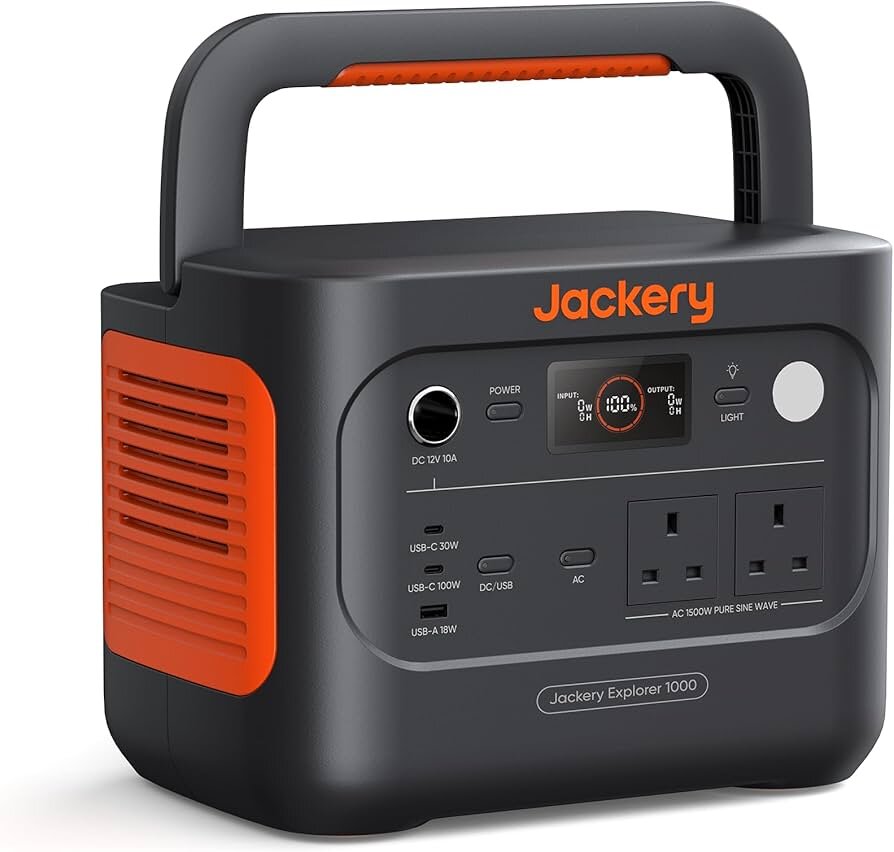
4. Jackery Explorer 1000 v2 — Best for running a fridge
Best for fridgesIf running a fridge during a power cut is the goal, this is the pick. The 1070Wh capacity combined with a 3000W surge rating means it can both start and sustain most UK fridge compressors — giving you 6–8 hours of fridge runtime from a full charge. Strong at keeping multiple devices running simultaneously too. Watch for sales, as it regularly drops under £500.
Pros: Best-in-class surge rating here (3000W), most capacity under £500 at sale price, strong solar input options.
Cons: Heavier (10.4 kg); full retail price can exceed £500 — set a price alert.
View on Amazon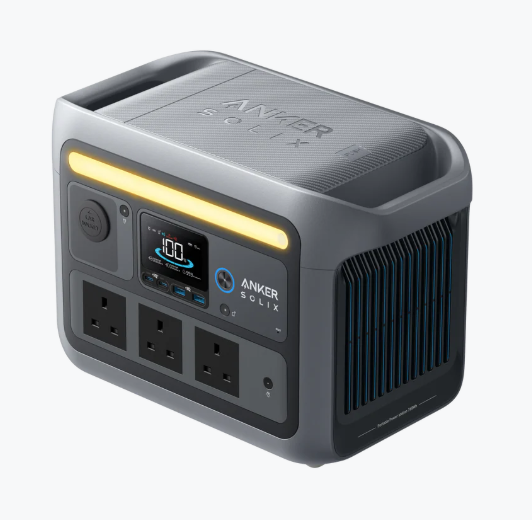
5. Anker SOLIX C800 — Best Anker pick
Reliable brandThe SOLIX C800 is Anker's answer to the EcoFlow RIVER 2 Pro — same capacity (768Wh), similar price bracket, but with a higher 2400W surge rating that gives it a genuine edge for fridge duty. Anker's warranty support and build quality reputation make this a slightly lower-risk purchase for those who prefer a known consumer electronics brand over specialist power companies.
Pros: 2400W surge (highest among 768Wh units here), Anker build quality, good app, car port included.
Cons: Heavier than EcoFlow equivalent; slower wall recharge than RIVER 2 Pro; 800W continuous is the same limitation.
View on Amazon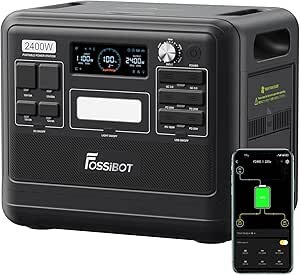
6. FOSSiBOT F2400 — Whole-home backup
PremiumIf your goal is genuine whole-home backup — keeping a full-size fridge running for 24+ hours while also charging phones, running lighting, and maybe a TV — the FOSSiBOT F2400 is the step up you need. At 2048Wh with 2400W output and 4800W surge, it can handle essentially everything short of an electric oven or shower. The 27kg weight means it stays put once positioned.
Pros: Largest capacity here, 4800W surge handles almost any UK appliance, UPS function (<30ms), fast recharge.
Cons: 27kg is not portable in any meaningful sense; significant investment; FOSSiBOT is a newer brand with less UK track record than Jackery/EcoFlow.
View on AmazonHow to choose the right power station for a UK power cut
Step 1: Work out what you actually need to power
Before looking at any products, list the devices you'd want running in a cut. A typical UK household priority list looks like: Wi‑Fi router + ONT (~20W), smartphones (10W each), a laptop (45W), and LED lighting (~15W total). That's roughly 90W — meaning a 500Wh unit gives you 4–5 hours, and a 1000Wh unit gives 8–9 hours. Fridges are a separate conversation (see below).
Step 2: Calculate the capacity you need
The formula is: required Wh = (total watts × hours needed) ÷ 0.8. The 0.8 accounts for inverter efficiency losses. So if you want to run 90W of devices for 8 hours: 90 × 8 ÷ 0.8 = 900Wh. That points to a 1000Wh unit. For a full guide to this calculation, see our power station sizing guide.
Step 3: Output watts and surge — especially if you want to run a fridge
Capacity is the tank. Output is the engine — and both need to be big enough. Fridge compressors draw 3–6× their running watts for a split second on startup. A unit with a 1500W+ surge rating is your minimum for fridge duty. Units with only 500–800W surge won't reliably start most UK fridge compressors even if the tank is full. For a full analysis, see our fridge guide.
Step 4: Battery chemistry — why LiFePO4 matters
All picks in this guide use LiFePO4 (LFP) chemistry. LFP is thermally stable (no fire risk), rated for 2000–4000 charge cycles (vs ~500 for older NMC), and holds capacity better over time. If you see a cheaper unit using NMC chemistry, factor in a shorter effective lifespan and higher replacement cost.
Step 5: Recharge speed
How quickly can you refill the tank when power returns? EcoFlow's 55-minute wall recharge (RIVER 2 Pro) is the current benchmark. Most others take 1.3–1.7 hours from flat. If you live somewhere that experiences repeated short cuts (common in rural UK), faster recharge is disproportionately valuable.
A note on indoor safety
Battery power stations are fully safe to use indoors — they produce no emissions, no fumes, and no carbon monoxide. This is fundamentally different from petrol generators, which must never be used inside. Keep your unit in a dry, ventilated area away from direct heat, and you're good.