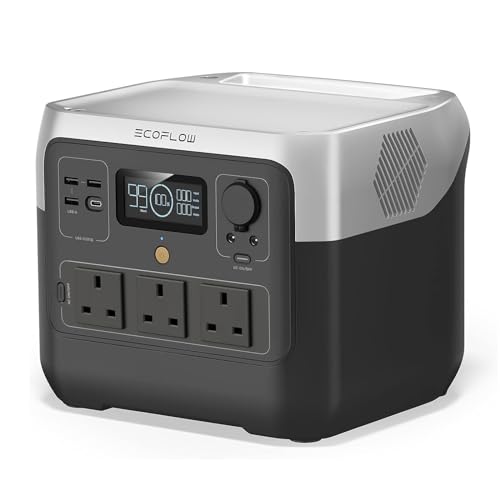
Best power station for a campervan (UK 2026)
A portable power station has become the simplest way to power a campervan: no leisure-battery install, no inverter wiring, no split-charge relay. One box runs your fridge, lights and laptop — and comes out of the van when you need power elsewhere. Here are the four we’d actually bolt a strap around, sized against real van-life loads.
What a campervan actually draws
Van power needs are smaller than most people think. The fridge is the only 24/7 load, and compressor fridges are efficient: around 45W running, cycling roughly a third of the time once cold. Everything else is intermittent.
| Load | Typical draw | Daily use | Daily energy |
|---|---|---|---|
| Compressor fridge (12V) | 45W (~35% duty) | 24h | ~380Wh |
| LED lighting | 10W | 4h | 40Wh |
| Laptop | 60W | 3h | 180Wh |
| Phones & tablets | 15W | 3h | 45Wh |
| Diesel heater (controller & fan) | 15–30W | 6h (winter) | 90–180Wh |
| Water pump | 50W | 15 min | ~12Wh |
A realistic summer day is 600–700Wh; winter with the heater running pushes towards 800Wh. That’s why 768Wh-class units are the campervan sweet spot: one day fully off-grid with zero input, indefinitely with 200W of solar.
Power station vs leisure battery install
| Portable power station | Leisure battery + inverter install | |
|---|---|---|
| Fitting | None — strap it down | Wiring, split-charge/DC-DC, fusing, mounting |
| 240V sockets | Built in, pure sine | Separate inverter needed |
| Solar | Plug and play (MPPT built in) | Separate charge controller |
| Usable outside the van | Yes — house, garden, power cuts | No — fixed install |
| Cycle life (LiFePO4) | 3,000+ cycles | Varies; lead-acid far lower |
| Resale / moving van | Take it with you | Usually stays with the van |
The maths used to favour a DIY lead-acid install. LiFePO4 power station pricing has closed that gap — and a power station doubles as home power-cut backup for the 50 weeks a year the van is on the drive.
Our top four picks for UK campervans
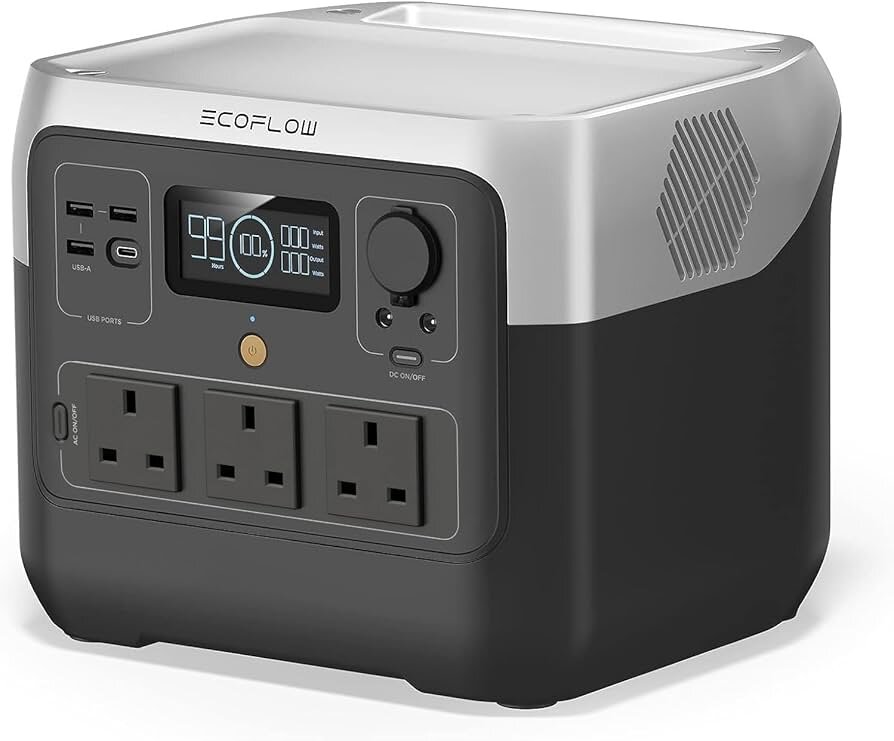
1. EcoFlow RIVER 2 Pro
The RIVER 2 Pro hits the campervan sweet spot: 768Wh covers a full off-grid day including the fridge, it’s light enough to lift out one-handed, and the 70-minute mains recharge means a café stop or an hour on EHU fully refills it. The built-in MPPT takes up to 220W of solar — a single portable panel on the dashboard or roof keeps the fridge running indefinitely in a UK summer.
X-Boost stretches the 800W output to run a 1,600W kettle or travel hairdryer — genuinely useful in a van where every appliance battle is fought at breakfast. LiFePO4 chemistry is rated for 3,000+ cycles, so daily van-life use won’t wear it out for a decade. The app’s live wattage readout also settles every ‘what’s draining it?’ argument instantly.
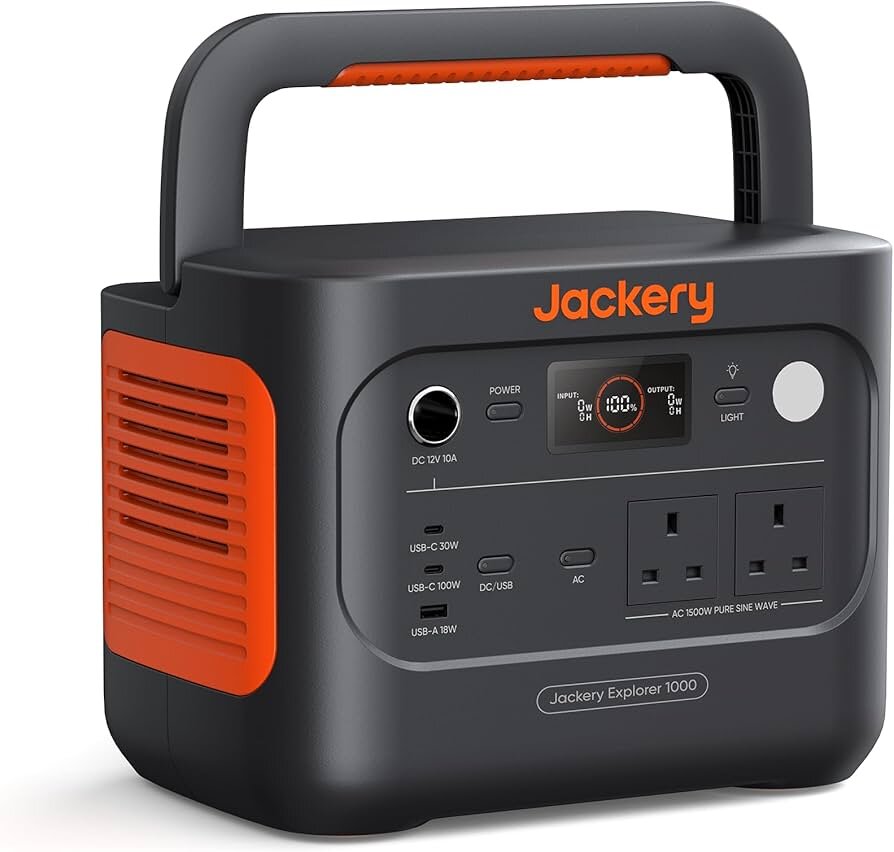
2. Jackery Explorer 1000 v2
If the van is your office or your home, step up to the Explorer 1000 v2. The 1,070Wh capacity gives you headroom for winter heater running, camera batteries and a proper laptop workday, and 1,500W continuous output runs an induction hob or coffee machine — things the 800W class can’t touch without boost tricks.
It’s still one-person liftable at 10.8kg, charges fully from mains in about an hour, and takes 400W of solar input, which is enough to fully recover a day’s use from a UK summer’s sun. Jackery’s 5-year warranty and the v2’s move to LiFePO4 fix the biggest criticisms of the older 1000.
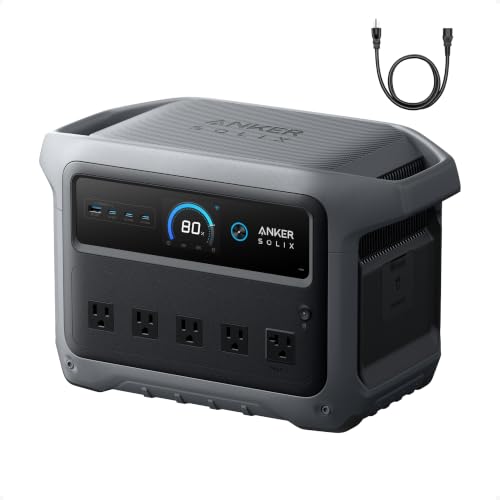
3. Anker SOLIX C1000 Gen 2
Anker’s C1000 Gen 2 replaces the old C800 with a third more battery and 2,000W of native output — kettles, hairdryers and travel cooking gear run without boost tricks, and 1,024Wh comfortably covers an off-grid day including the fridge. HyperFlash recharging refills it in about 49 minutes on hook-up.
Against the RIVER 2 Pro it’s heavier and the app is less polished, but you get more battery and far more output for the money. As a set-and-forget van battery that mostly lives strapped under a seat, it’s arguably the strongest value in this list.
4. EcoFlow RIVER 3 Max
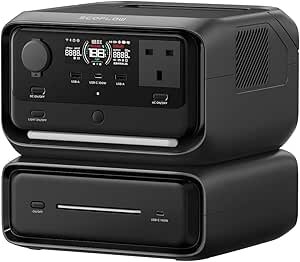
For weekend and festival vans that don’t run a fridge full-time, the RIVER 3 Max covers lights, phones, laptop and a camera kit for two days at a noticeably lower price. It’s the smallest and lightest unit here, slides under most van seats, and keeps the same LiFePO4 longevity as its bigger siblings.
You give up sustained fridge-plus-everything endurance — with a compressor fridge on board expect a nightly top-up from driving or solar. If a fridge is central to your setup, spend more on the RIVER 2 Pro; if it isn’t, this is all the battery most weekenders ever use.
Quick comparison
| Model | Capacity | Output | Weight | Best for | |
|---|---|---|---|---|---|
| EcoFlow RIVER 2 Pro | 768Wh | 800W (1,600W boost) | 7.8kg | Most vans | £499 on Amazon UK |
| Jackery Explorer 1000 v2 | 1,070Wh | 1,500W | 10.8kg | Full-time van life | £398 on Amazon UK |
| Anker SOLIX C1000 Gen 2 | 1,024Wh | 2,000W | ~11kg | Value & high output | £474 on Amazon UK |
| EcoFlow RIVER 3 Max | 572Wh | 600W (1,200W boost) | 8.4kg | Weekenders | Check price on Amazon UK |
Keeping it charged on the road
12V socket while driving: every unit here charges from the accessory socket at roughly 100W. It’s slow — think of it as fridge-offset rather than a real recharge — but it’s free power on every drive.
Solar: a 200W portable panel realistically yields 600–900Wh on a clear UK summer day and 150–300Wh in winter. All four picks have MPPT controllers built in, so it’s literally one cable. Park nose-south, prop the panel against the windscreen, done.
Campsite hook-up: an hour on EHU fully recharges any of these — their fast-charge rates (600–1,000W+) are the quiet superpower of this generation. One serviced pitch per week can sustain indefinite off-grid touring.
Winter caveat: LiFePO4 cells won’t accept charge below 0°C — the BMS blocks it to protect the battery. Warm the van before charging on frosty mornings. Using the battery in the cold is fine.
Frequently asked questions
PCRRelated guides
- Best portable power stations for camping — tent and festival focused picks
- Best portable power stations UK — the full six-pick roundup
- Best power stations under £500 — budget-first shortlist
- EcoFlow RIVER 2 Pro review · Jackery Explorer 500 v2 review · Anker SOLIX C1000 Gen 2 review
Prices change frequently on Amazon — tap any Check price button to see today’s price. Some links are affiliate links; we may earn a commission at no extra cost to you.